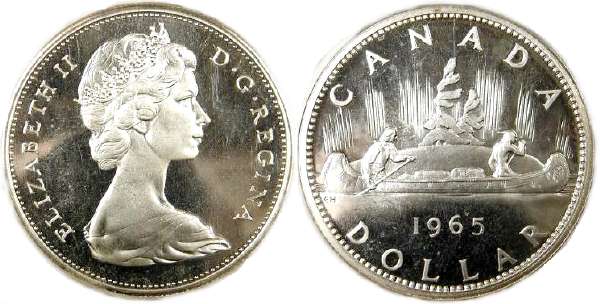
I would like to open a series of topics on coins of a single country to gather some of our knowledge. This could be about likes and dislikes, values, where best to obtain them, numismatic trivia and history.
Starting at the top left of the world map is Canada.
I don't have a strong preference for Canadian coins. They hardly changed designs (typical for a hard currency) and as Neil already pointed out they have too many commens.
The old pre-1936 quarters and higher denominations are pretty hard to find in VF or better. Canadian coins are quite expensive to my experience.
The Canadian Dollar replaced the British Pound in the 1860's or so (not exactly sure which year for 4s2d or 50 old pence per C$. This means a Canadian cent was worth a half British penny and a quarter slightly more than a shilling. It was almost at parity with USD and remained very stable against USD over the last 150 years, with a few ups and downs due to economical divergences following oil price moves.
The Canada dollar is called the Loonie as the 1 dollar coin features a loon from 1987. The 2$ coin is named Toonie (two loonies). Not sure if other nicknames are used.
Back to collecting, I just ignore the commems and have around 40 types. Every 10 years or so I patiently pick up a new portrait series whenever they are reasonably priced. Here in Europe it's not very easy to find George V or older Canadian coins in decent quality, especially the silvers.
The Newfoundland coins are nice in a historical context. Occasionally I found some for around 5 EUR a piece.
I really like Canadian coins overall. I collect Canadian coins almost as much as U.S. coins. Canada has overdone it, though, on commemorative and gimmick coins in recent decades. But if people buy them, the Canadian mint will keep on minting them, and same is true for the current commemorative craze around the world.
I like the Canadian nickel. The Beaver motif is great. And one of my favorite coins is the Canadian V for victory war nickels.
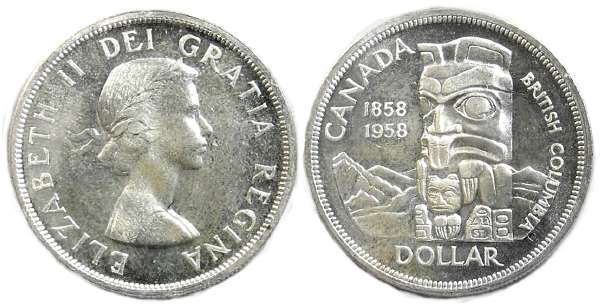
I also really like Canadian dollars. My favorite is the 1958 British Columbia dollar.
A lot of the Canadian commemoratives do circulate. There are well over a hundred commemorative coin types in circulation, most of them - quarters, including some colored ones.
As with all the member nations of the Commonwealth, all Canadian coins have the British monarch's portrait on them.
The last silver Canadian circulation coin was the 1972 .500 dollar, and 1968/69 for quarter and dime, correspondingly.
50 cent coins virtually do not circulate and pretty much the only place you'll find them is in sets or at banks.
Canadian 1 cent coins were last issued in May of 2012. At that time, the melt value was more than double the face value.
Circulating commems are legit. They spark the interest of new collectors and make it fun to inspect your change now and then. I just don't collect them to keep room for all the other interesting world coins I can find.
How much would one expect to pay for a silver Canada 25 or 50 cents from before 1920 in VF or better condition? I've only encountered very worn ones so far so I never got to acquiring any.
I love Canadian coins, despite my other post. I mainly collect Silver and then pre-1945 coins, so Canada is the perfect country to collect because they have so many silver coins. I even have commemoratives, I own the 1967 centenary coins. But I just get annoyed with having to scroll through screens of commemorative 25c coins to try and find where the silver 50c coins start.
I've been getting into the Canadian provincial coins recently as well. I like the designs of their old copper coins. I picked up these ones the other day
There is a thing I still don't understand: why are there 2 different shapes on these maple cents...
But a funnier data: did you know that Newfoundland coinage, which was a separate dominion before joining Canada, is still legal tender in Canada? According to a currency act, whose parts concerning Newfoundland coinage are still valid, you may pay or receive cash from the former Dominion of Newfoundland. Just notice by the same way both Canadian and Newfoundland dollars were at par and last coinage was similar. For example, a George VI 1 cent had the same size, weight and composition as Canadian ones.
Administrateur du catalogue, référent de nombreuses nations antiques et de la Lorraine.
Catalogue administrator, numerous Antique nations and Lorraine referee.
Many of those "old provincial coins" are tokens, as Canada did not get real coins made for its entire territory until 1858. Before then, we used a mixture of American and British coinage, plus the odd colonial issue and some privately issued tokens for small change - they might not be coins but they are still hotly collected. Most were issued by merchants, a few looked like "real" coinage, and later tokens were even issued by some especially cocky private banks (like the Bank of Montreal, which is still one of Canada's largest banks). I have a few of these.
If you want to divide up earlier colonial Canada, you have English-speaking Upper Canada (now Ontario), French-speaking Lower Canada (now Quebec), and the Maritime provinces on the Atlantic (New Brunswick, Nova Scotia, Newfoundland, and Prince Edward Island). The Maritime provinces were some of the first to be settled by Europeans. In the 1840s, Upper and Lower Canada combined into the Province of Canada, but this unitary Province had big problems between the English and French and there was a struggle for a better form of government. In 1867, that form of government was found in a Confederation between the Province of Canada, Nova Scotia, and New Brunswick. The Province of Canada was promptly divided back into its two halves and English and French Canada have argued ever since. Prince Edward Island and Newfoundland stayed out of Confederation for some years, and most of Western Canada was very sparsely populated and had no governmental representation or coinage at the time.
Pre-Confederation Tokens:
A "half penny token" from Upper Canada. Notice how they copied the British design.
"Un sou" from the long-defunct Banque du Peuple in Montreal. The Quebecois issued a lot of (technically illegal) tokens.
Another half penny token, this one from the Bank of Montreal and meant for use in the entire Province of Canada.
Pre-Confederation Coins:
The Prince Edward Island cent, one of the "must-have" coins for any Canadian collector. They are not very expensive because the P.E.I. government produced way too many of these coins - they struggled to get rid of the surplus for years. At one point, you could purchase these coins for 0.9 cents each! Once P.E.I. joined Confederation, these circulated alongside Canadian large cents until the year 1920, when the Canadian cent was downsized.
A small cent from Newfoundland, featuring the carnivorous pitcher plant, one of the few things that grows in Newfoundland's poor soil.
A dime from Newfoundland. Newfoundland silver is highly sought after by collectors in all provinces.
But Canada has always been a bit of a loose confederation, and some provinces still issued their own currency. I live in the Western province of Alberta (created in 1905). Two days ago, we elected our first new government for 43 straight years - that's the kind of one-party rule you expect in the Eastern Bloc, not Western Canada, so this election made national news. (Note to Americans: our new government will not build the Keystone XL pipeline. Thanks Obama!) Anyway, in our province we have a tendency to have political dynasties that stay in power for decades. We have just unseated the Progressive Conservative Association, and they, in turn, unseated the "Social Credit Party" way back in 1971.
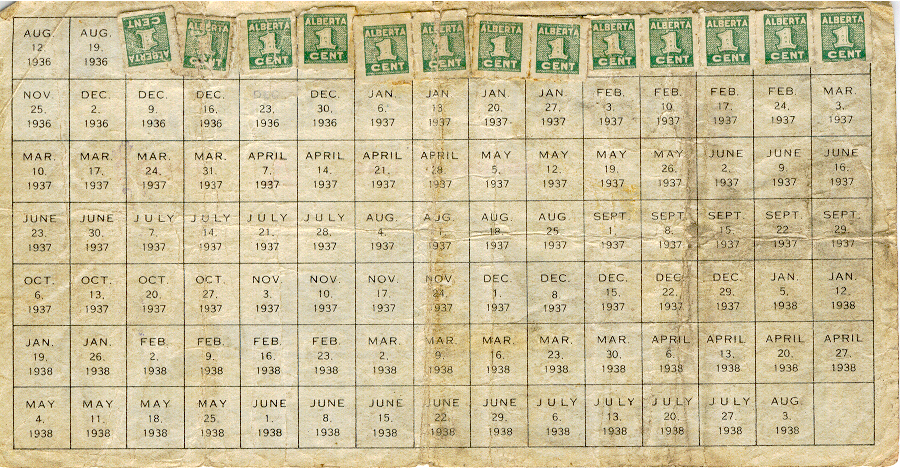
The Social Credit Party is interesting for their insane ideology, which combined rural Christian fundamentalism with bizarre almost-Communist policies - they tried to nationalize all of the province's banks and curtail freedom of speech. One of their weird political ideas was to issue "Prosperity Certificates" to solve the Great Depression. The idea behind the "Prosperity Certificates" was that the government would give away free money, but this money would only be valid if you put a new stamp on it every week. Stamps were sold for 1 cent each and there were spaces for 104 stamps - so at the end of the program, the government would have actually made a profit. However, the stamps kept falling off and the idea was stupid, so the program was scrapped. These Certificates were printed locally and are now quite rare and expensive, but they're very high up on my most-wanted currency list. (This one's not mine.)
I also have some newer Canadian coins and currency, but this post is already too long so maybe I'll post them later.
Even though the provincial coins are officially tokens, they circulated and were accepted as legal currency by the locals, the same as the merchant tokens in New Zealand. New Zealand didn't start minting halfpennies and pennies until 1940, before that most of the lower values were merchant tokens. Since everyone accepted them as currency, I tend to refer to them as "coins" rather than "tokens"
Thanks Nalaberong! Your post was even too short as everything in it was hugely interesting! It increased my knowledge and enthusiasm for Canadian coins.
I am still looking for a PEI cent and silver quarters and halves from before 1920. Are NGC anywhere reliable for Canadian coins?
I have three of those coins you posted. The exact same 1942 Newfoundland cent the Bank of Montreal 1/2 penny, and penny from Prince Edward Island. I luckily found the Newfoundland cent in a bargain bin.
I collect Canadian coins.
Now Canada is on my Top-10 countries (5 place 165 coins)
I like design of your coins and 25 cents))
I have never been in Canada, but i think its perfect and very interesting country
I used to have a large amount of Canadian coins since I live fairly close to Canada. However, I have narrowed it down to the commemorative 1$ silver coins from the 30s to the 60s. I love those pieces!
Great large cent collection. That's one area I haven't gone too far into - my Canadian collection is pretty poor by Canadian standards because of how much everything costs. Someone was asking about pre-1937 Canadian coin prices in good condition - my 2013 Charlton catalog says that the cheapest of the King George V 50-cent coins in VF will cost you $50. Ouch. XF is $150. The vast majority of these coins seem to be worn smooth and/or heavily polished, so I can understand why the prices are so steep. This is my best-looking George V silver:
Now, some of you who know the American coin market know that almost all American coins have to be "professionally graded" and encased in hard plastic "slabs" before anyone will buy them. (Grading costs upwards of $15 per coin and the experts spend about ten seconds looking at each submission.) The Canadian coin market also has a strong emphasis on "third-party grading", but there is only one grading company that is based in Canada and trusted by Canadian dealers (compared to three companies in the USA) - "International Coin Certification Service", or ICCS. ICCS puts your coins in sealed plastic "flips", which are a bit fragile and are definitely a far cry from the durable and secure "slabs" - but they are widely trusted regardless. I have only two coins that are in ICCS holders and I bought them because they were extremely cheap - someone wasted a lot of money getting these two low-value rejects professionally authenticated:
Almost all valuable Canadian coins are bought and sold inside these holders.
Another similarity with America is that Canadian coins are either quite expensive or completely worthless. Silver coins from the reign of Elizabeth II are bought and sold by weight, even in UNC, even including the dollars! But all coins from the reign of Victoria are valuable. I have heard that Canadian dollars are popular, so I guess I can share pictures of those by type.
The Most Valuable Canadian Coin - 1911
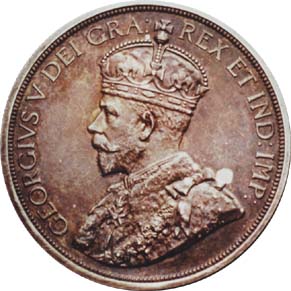
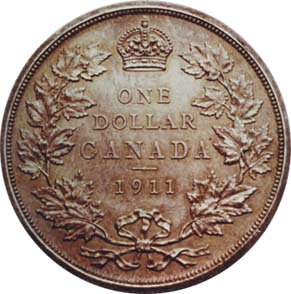
A Canadian silver dollar was originally planned in 1911, but for some reason it was never issued. Three exist today - two struck in silver, one struck in lead. I have seen one silver and the lead issue with my own eyes, because they are permanently in the Bank of Canada's publicly accessible currency museum in Ottawa. (For any serious collectors near the border, this museum might be worth making a driving trip for - they are closed for renovations but will be re-opening soon.) But one silver issue remains in the hands of private collectors. Last time it came to auction, in 2003, it sold for $690,000. If it were sold today, it is estimated to be worth $1,250,000.
The First Production Silver Dollar - 1935
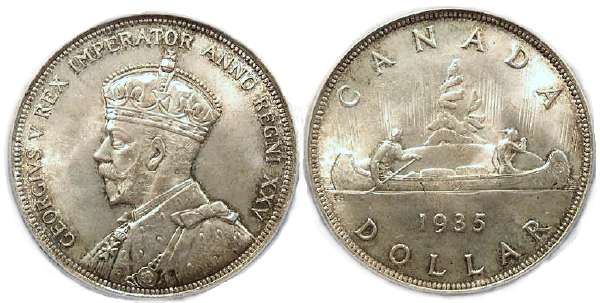
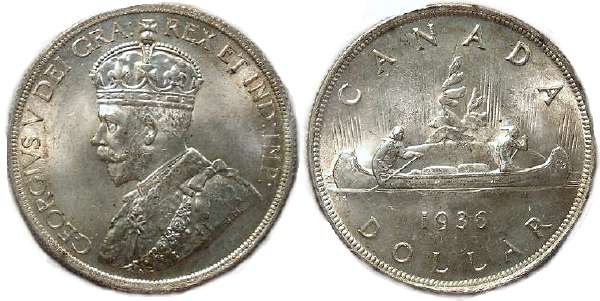
The first "circulating" Canadian silver dollar was a commemorative, issued to commemorate the 25th year of King George V's reign. It used a slightly variant portrait of George V, designed for use on the coins of New Zealand, and it has a special legend. This coin is not very expensive but you won't be able to buy it for its silver value. This marked the first use of the famous "voyageur" design, with a voyageur and a Native American paddling in the same canoe under the Northern Lights. The voyageurs were some of the first Europeans to really explore Canada, as they traveled through rivers in search of valuable beaver furs to trade for. Many of these furs were bought by the Hudson's Bay Company, established by English royal decree in 1670. This makes the H.B.C. the oldest company in North America, because it still exists - now it's a chain of department stores called "The Bay". If you look very closely at the bundles in the canoe on this coin, you can see the letters "HB" (Hudson's Bay) on one of them.
The First Non-Commemorative Production Silver Dollar - 1936
In 1936, the silver dollar proved that it was not just a one-off issue (unlike similar coins from Australia and New Zealand, which only saw production in 1937 and 1949 respectively). No, it was a definitive series. Unfortunately, this type also only lasted one year because of the death of King George V.
King George VI Takes the Mantle - 1937 - 1947
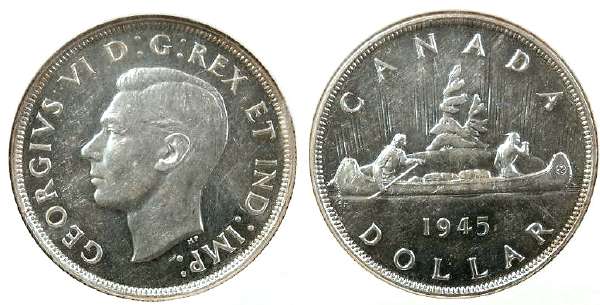
The updated type with King George VI lasted for 10 years, but there was a big break in production during World War II. No silver dollars were produced between 1940 and 1944.
The Royals Come to Town - 1939
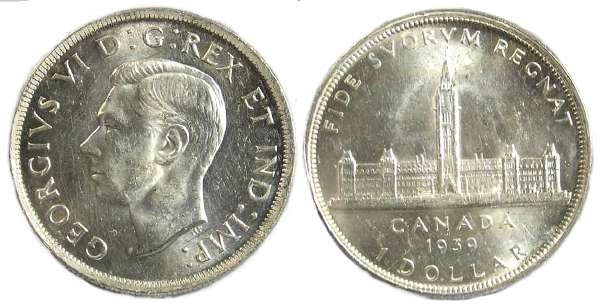
Just four months before the outbreak of WWII, King George VI and his family toured all through Canada. No expense was spared for this month-long tour and they visited every province (plus Newfoundland). The royals laid cornerstones, unveiled monuments, approved legislation, and generally stayed constantly in the public eye. As part of this grand event, the 1939 silver dollar was struck with a commemorative design. Many of these were kept in perfect condition as souvenirs, so prices are low even in the uncirculated grades.
India Leaves The Fold - 1948 - 1952
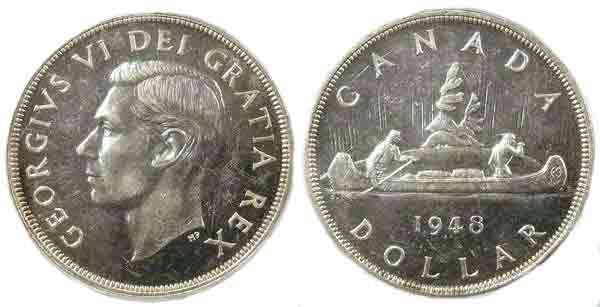
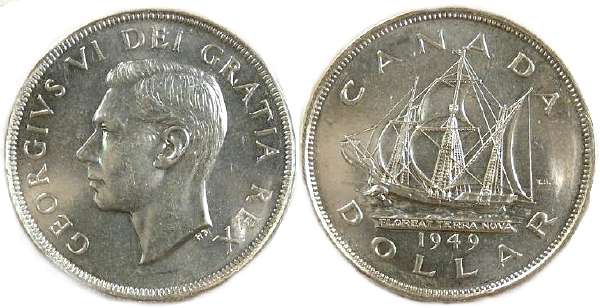
In 1947, India became independent, meaning that King George VI could no longer claim the title "Emperor of India". That meant that almost every coin in the entire British Empire was now inaccurate, because they all said something like "George VI: King and Emperor". In Canada, that claim was made in abbreviated Latin ("Georgivs VI D.G. Rex Et Ind. Imp." stands for "Georgivs VI Dei Gratia Rex et Indiae Imperator" which means that George VI, by the Grace of God, is a King and he is also Emperor of India). This coin reflects his new status. Because of the difficulty in amending the coin legend in time for 1948 (all dies were produced at a distance in London and sent to Canada, a lengthy process), the 1948 silver dollar is the most expensive of the Voyageur series.
Newfoundland Joins Canadian Confederation - 1949
As previously mentioned, Newfoundland was once a separate Dominion from Canada, ruled directly from London. But Newfoundland had fallen on hard times and was bankrupt, and Britain didn't want to pay the bills. So the politician Joey Smallwood relentlessly campaigned to convince Newfoundlanders to join Canada. (The alternative was probably a purchase by the United States.) It worked and Mr. Smallwood became the first Premier of the new province in 1949. This event was commemorated with a beautiful coin, my favourite design out of the entire silver dollar series.
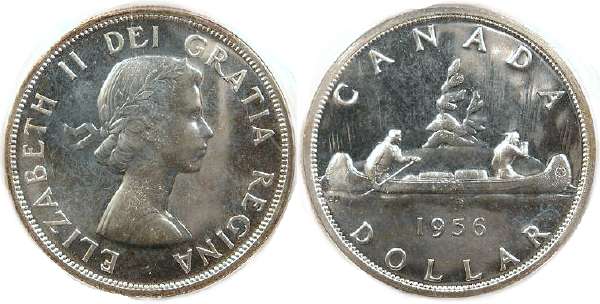
Young Elizabeth II - 1953 - 1963
Upon the death of her father George VI (at the old age of 56, from lung cancer - don't smoke!), Elizabeth II took the throne. Her first portrait was drawn by Mary Gillick and showed the young queen wearing laurels, instead of the traditional crown. For this reason, this portrait is called the "Laureate" bust.
Centennial of the British Rule of British Columbia - 1958
British Columbia is Canada's only province to have a Pacific coastline. Its mountain ranges protected its many native tribes from total annihilation, so the Native American artwork from there has become world-famous (for instance, the well-known "totem poles" are not really found in any other province). This coin was struck to commemorate the 100th anniversary of British Columbia as a British territory. Like Newfoundland, British Columbia was under direct British rule for some decades before joining Canada.
There is a rumour that the totem pole on this coin is a depiction of a native god of Death and that the coins are very unlucky, but that rumour seems to have no basis in fact.
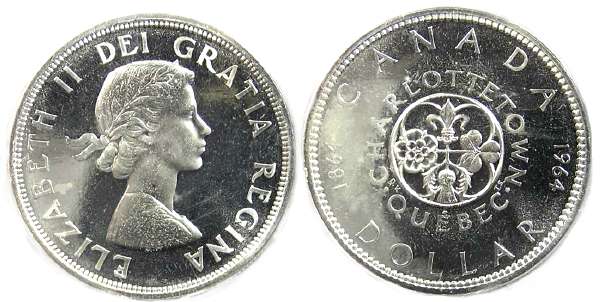
Centennial of the Charlottetown and Quebec Conferences - 1964
Heated negotiations in the year 1864 began the process of uniting all of Britain's possessions in North America into one single possession - Canadian Confederation. The hard part was getting the French Canadians on board, and dealing with the demands of people from remote provinces. This coin is for the centennial of those negotiations, held in Charlottetown and Quebec City.
Older Elizabeth II - 1965 - 1966
In 1964 Elizabeth II's portrait was updated.
Centennial of Canadian Confederation - 1967
Confederation finally happened on July 1, 1867, uniting Ontario, Quebec, Nova Scotia, and New Brunswick. The centennial of this event, then, was in 1967. This was a very big event and celebrations were held in every town in the country. To this day, most Canadian towns have a monument or park that was first opened or dedicated during the Centennial in 1967. All 1967 coins have a special commemorative design, designed by the late artist Alex Coville.
This is the end of the circulating silver dollar series. After 1967, Canada began switching from silver to nickel metal. Nickel is a very hard metal and the Mint found out that it was very difficult to strike full-sized dollar and 50-cent coins in nickel - so both of those denominations were downsized in 1968. This began a brand-new series of made-for-circulation "nickel dollars", which really didn't circulate very much and were eventually replaced with the famous "loonie" in 1987. The Mint also started producing a series of .500 silver dollars in special cases for collectors only - that series is still going on to this day.
The history of the voyageurs is a very good read, beaver pelts paved the way and paid the way for the colonization of North America, Beavers and Tobacco in Virginia were the only two major exports of North America for more than 100 years and beyond. I must say its a shame the French lost the French and Indian war (seven years war) because they treated the Natives far better than the British and other colonists.
This was (is?) a great thread. As I am trying to complete my Canadian Penny collection and I am a new member, I am going to add my 2 cents worth.
The 1858/59 Large Cent is considered the 1st Canadian coin and was issued for the "Province of Canada" by the Heaton Mint in Britain. The government of the time optimistically ordered 10,000,000 coins: 421,000 1858 and 9,579,000 1859. This proved to be much more than we could absorb as we were inundated with copper tokens from banks and individuals alike. Because the existing "old" tokens were much thicker than the new "thin" cent, public acceptance was poor (so much for marketing in the 19th century). The majority of the issue remained in the original boxes, except for a small portion given to New Brunswick in 1861. The Bank of Upper Canada retained the bulk of the inventory until its closing in 1866.
The Dominion of Canada was formed in 1867, Canada's Birthday, and the new government inherited several million Large Cents. These coins included the original 1858, restrikes over the 8 with a wide 9, narrow 9's, double strikes, bronze, brass, etc. Good luck to the collector that can assemble this cornucopia of KM#1.
Canada did not have another Large Cent issue until 1876, a full 9 years after Confederation (and 18 years after the first strike)! It would appear that the silver 5 Cent and 10 Cent coins suffered roughly the same fate: next 5 cent and 10 cent strike was 1870.
Lastly, the one and only, 20 cent Canadian coin was struck in 1858. It seems we were still deciding between the British shilling, pence, crown, et al system and the decimal system to our neighbours of the south. In good Canadian fashion (politeness), we adopted the decimal system and in 1870 the first 25 cent coin was struck.
Hoping this little piece was inciteful......Peter
It ain't what you don't know that gets you into trouble. It's what you know for sure, that just ain't so. Mark Twain
Peter ---great to see you collecting large cents, but I have to put you right on a couple of things
Mintage 1858s 1,540,000 1859s 8,150,000
Heaton Mint made the blanks and milled them also annealed them and then they where sent to the Royal Mint for striking .
Go here for 59 varieties http://www.vickycents.com/index.html
and here for other helpful info 1858s and more http://www.victoriancent.com/index.html
PS
I have 25 only 59s (400 to go)and 2 58s but all different and they are great to collect .
If I can help you with other info --please let me know
Jokinen - Thanks for the correction of my poor grammar
Don - Thanks for your correction too. I was using my Grandpa's Carlton Standard Catalog from 1985. Also, thanks for the links. I find that half of the fun of collecting is the history.
Kind Regards, Peter
It ain't what you don't know that gets you into trouble. It's what you know for sure, that just ain't so. Mark Twain
Seems like this chat's been inactive for quite some time. Since we have sections for talking about coins from different countries, maybe it would be a good idea to also have chats for banknotes from different countries
Also, might as well give a Canadian numismatic fact while I'm here:
Back in 2013, the International Coin Certification Service had only 290 no-logo pennies from 2006 in Canada on record. However, one man in Ontario managed to find more than 500 of them after looking through some pennies he bought from the bank in 2006. He had 5,000 pennies in all. Providing he sold the no-logo pennies at the asking price, he would make over $300,000 CAD. Certainly quite a lucky find.
Can someone talk a little about the 2019 loonie of LGBT+ equality?
I'm really interested on these... How common is it? Is common circulation, or collectors edition?
Citação: "lhlimaverde"Can someone talk a little about the 2019 loonie of LGBT+ equality?
I'm really interested on these... How common is it? Is common circulation, or collectors edition?
it’s available in common circulation. I haven’t dealt with cash much in the last couple years and haven’t done any coin roll hunting either. So I don’t know if it’s easy to find it in circulation these days. But they are definitely out there in decent quantity I think
neilithicI love Canadian coins, despite my other post. I mainly collect Silver and then pre-1945 coins, so Canada is the perfect country to collect because they have so many silver coins. I even have commemoratives, I own the 1967 centenary coins. But I just get annoyed with having to scroll through screens of commemorative 25c coins to try and find where the silver 50c coins start.
I've been getting into the Canadian provincial coins recently as well. I like the designs of their old copper coins. I picked up these ones the other day
And I have another on the way.
I actually found numista because of my canadian cents. I started collecting in 1955 and amassed a large amount of canadian and mexican coins in my change ( collected only US at that time) .Wanted to find a place I could trade all of them for US coins I needed. After cataloging all my canadian cents I found I had almost a complete collection! That was my canadian start. I have almost complete collections of both cents and nickels as well as extensive collections of quarters (including comm.) and toonies. For the last year or so I have been into pre confederation tokens and maritime provincial. I'm also pretty heavy into the NGC Registry and have many canadians sets there. Love the pics!. Beautiful coins
If you don't stand for something you'll fall for anything
Many of those "old provincial coins" are tokens, as Canada did not get real coins made for its entire territory until 1858. Before then, we used a mixture of American and British coinage, plus the odd colonial issue and some privately issued tokens for small change - they might not be coins but they are still hotly collected. Most were issued by merchants, a few looked like "real" coinage, and later tokens were even issued by some especially cocky private banks (like the Bank of Montreal, which is still one of Canada's largest banks). I have a few of these.
If you want to divide up earlier colonial Canada, you have English-speaking Upper Canada (now Ontario), French-speaking Lower Canada (now Quebec), and the Maritime provinces on the Atlantic (New Brunswick, Nova Scotia, Newfoundland, and Prince Edward Island). The Maritime provinces were some of the first to be settled by Europeans. In the 1840s, Upper and Lower Canada combined into the Province of Canada, but this unitary Province had big problems between the English and French and there was a struggle for a better form of government. In 1867, that form of government was found in a Confederation between the Province of Canada, Nova Scotia, and New Brunswick. The Province of Canada was promptly divided back into its two halves and English and French Canada have argued ever since. Prince Edward Island and Newfoundland stayed out of Confederation for some years, and most of Western Canada was very sparsely populated and had no governmental representation or coinage at the time.
Pre-Confederation Tokens:
A "half penny token" from Upper Canada. Notice how they copied the British design. "Un sou" from the long-defunct Banque du Peuple in Montreal. The Quebecois issued a lot of (technically illegal) tokens. Another half penny token, this one from the Bank of Montreal and meant for use in the entire Province of Canada.
Pre-Confederation Coins:
The Prince Edward Island cent, one of the "must-have" coins for any Canadian collector. They are not very expensive because the P.E.I. government produced way too many of these coins - they struggled to get rid of the surplus for years. At one point, you could purchase these coins for 0.9 cents each! Once P.E.I. joined Confederation, these circulated alongside Canadian large cents until the year 1920, when the Canadian cent was downsized. A small cent from Newfoundland, featuring the carnivorous pitcher plant, one of the few things that grows in Newfoundland's poor soil. A dime from Newfoundland. Newfoundland silver is highly sought after by collectors in all provinces.
But Canada has always been a bit of a loose confederation, and some provinces still issued their own currency. I live in the Western province of Alberta (created in 1905). Two days ago, we elected our first new government for 43 straight years - that's the kind of one-party rule you expect in the Eastern Bloc, not Western Canada, so this election made national news. (Note to Americans: our new government will not build the Keystone XL pipeline. Thanks Obama!) Anyway, in our province we have a tendency to have political dynasties that stay in power for decades. We have just unseated the Progressive Conservative Association, and they, in turn, unseated the "Social Credit Party" way back in 1971.
The Social Credit Party is interesting for their insane ideology, which combined rural Christian fundamentalism with bizarre almost-Communist policies - they tried to nationalize all of the province's banks and curtail freedom of speech. One of their weird political ideas was to issue "Prosperity Certificates" to solve the Great Depression. The idea behind the "Prosperity Certificates" was that the government would give away free money, but this money would only be valid if you put a new stamp on it every week. Stamps were sold for 1 cent each and there were spaces for 104 stamps - so at the end of the program, the government would have actually made a profit. However, the stamps kept falling off and the idea was stupid, so the program was scrapped. These Certificates were printed locally and are now quite rare and expensive, but they're very high up on my most-wanted currency list. (This one's not mine.)
I also have some newer Canadian coins and currency, but this post is already too long so maybe I'll post them later.
Thanks for the history lesson! I knew some of it but you added some great detail.😺
If you don't stand for something you'll fall for anything
jokinenThanks Nalaberong! Your post was even too short as everything in it was hugely interesting! It increased my knowledge and enthusiasm for Canadian coins.
I am still looking for a PEI cent and silver quarters and halves from before 1920. Are NGC anywhere reliable for Canadian coins?
I have several canadian sets in the NGC Registry. TPG coins are starting to get expensive but there are quite a few around. I pretty involved in the registry and am getting ready to submit about 20 pre confederation and maritime cents and ½ cents
If you don't stand for something you'll fall for anything
neilithicI love Canadian coins, despite my other post. I mainly collect Silver and then pre-1945 coins, so Canada is the perfect country to collect because they have so many silver coins. I even have commemoratives, I own the 1967 centenary coins. But I just get annoyed with having to scroll through screens of commemorative 25c coins to try and find where the silver 50c coins start.
I've been getting into the Canadian provincial coins recently as well. I like the designs of their old copper coins. I picked up these ones the other day
And I have another on the way.
If you don't stand for something you'll fall for anything
neilithicI love Canadian coins, despite my other post. I mainly collect Silver and then pre-1945 coins, so Canada is the perfect country to collect because they have so many silver coins. I even have commemoratives, I own the 1967 centenary coins. But I just get annoyed with having to scroll through screens of commemorative 25c coins to try and find where the silver 50c coins start.
I've been getting into the Canadian provincial coins recently as well. I like the designs of their old copper coins. I picked up these ones the other day
And I have another on the way.
If you don't stand for something you'll fall for anything
nalaberongGreat large cent collection. That's one area I haven't gone too far into - my Canadian collection is pretty poor by Canadian standards because of how much everything costs. Someone was asking about pre-1937 Canadian coin prices in good condition - my 2013 Charlton catalog says that the cheapest of the King George V 50-cent coins in VF will cost you $50. Ouch. XF is $150. The vast majority of these coins seem to be worn smooth and/or heavily polished, so I can understand why the prices are so steep. This is my best-looking George V silver:
Now, some of you who know the American coin market know that almost all American coins have to be "professionally graded" and encased in hard plastic "slabs" before anyone will buy them. (Grading costs upwards of $15 per coin and the experts spend about ten seconds looking at each submission.) The Canadian coin market also has a strong emphasis on "third-party grading", but there is only one grading company that is based in Canada and trusted by Canadian dealers (compared to three companies in the USA) - "International Coin Certification Service", or ICCS. ICCS puts your coins in sealed plastic "flips", which are a bit fragile and are definitely a far cry from the durable and secure "slabs" - but they are widely trusted regardless. I have only two coins that are in ICCS holders and I bought them because they were extremely cheap - someone wasted a lot of money getting these two low-value rejects professionally authenticated:
Almost all valuable Canadian coins are bought and sold inside these holders.
Another similarity with America is that Canadian coins are either quite expensive or completely worthless. Silver coins from the reign of Elizabeth II are bought and sold by weight, even in UNC, even including the dollars! But all coins from the reign of Victoria are valuable. I have heard that Canadian dollars are popular, so I guess I can share pictures of those by type.
The Most Valuable Canadian Coin - 1911
A Canadian silver dollar was originally planned in 1911, but for some reason it was never issued. Three exist today - two struck in silver, one struck in lead. I have seen one silver and the lead issue with my own eyes, because they are permanently in the Bank of Canada's publicly accessible currency museum in Ottawa. (For any serious collectors near the border, this museum might be worth making a driving trip for - they are closed for renovations but will be re-opening soon.) But one silver issue remains in the hands of private collectors. Last time it came to auction, in 2003, it sold for $690,000. If it were sold today, it is estimated to be worth $1,250,000.
The First Production Silver Dollar - 1935
The first "circulating" Canadian silver dollar was a commemorative, issued to commemorate the 25th year of King George V's reign. It used a slightly variant portrait of George V, designed for use on the coins of New Zealand, and it has a special legend. This coin is not very expensive but you won't be able to buy it for its silver value. This marked the first use of the famous "voyageur" design, with a voyageur and a Native American paddling in the same canoe under the Northern Lights. The voyageurs were some of the first Europeans to really explore Canada, as they traveled through rivers in search of valuable beaver furs to trade for. Many of these furs were bought by the Hudson's Bay Company, established by English royal decree in 1670. This makes the H.B.C. the oldest company in North America, because it still exists - now it's a chain of department stores called "The Bay". If you look very closely at the bundles in the canoe on this coin, you can see the letters "HB" (Hudson's Bay) on one of them.
The First Non-Commemorative Production Silver Dollar - 1936
In 1936, the silver dollar proved that it was not just a one-off issue (unlike similar coins from Australia and New Zealand, which only saw production in 1937 and 1949 respectively). No, it was a definitive series. Unfortunately, this type also only lasted one year because of the death of King George V.
King George VI Takes the Mantle - 1937 - 1947
The updated type with King George VI lasted for 10 years, but there was a big break in production during World War II. No silver dollars were produced between 1940 and 1944.
The Royals Come to Town - 1939
Just four months before the outbreak of WWII, King George VI and his family toured all through Canada. No expense was spared for this month-long tour and they visited every province (plus Newfoundland). The royals laid cornerstones, unveiled monuments, approved legislation, and generally stayed constantly in the public eye. As part of this grand event, the 1939 silver dollar was struck with a commemorative design. Many of these were kept in perfect condition as souvenirs, so prices are low even in the uncirculated grades.
India Leaves The Fold - 1948 - 1952
In 1947, India became independent, meaning that King George VI could no longer claim the title "Emperor of India". That meant that almost every coin in the entire British Empire was now inaccurate, because they all said something like "George VI: King and Emperor". In Canada, that claim was made in abbreviated Latin ("Georgivs VI D.G. Rex Et Ind. Imp." stands for "Georgivs VI Dei Gratia Rex et Indiae Imperator" which means that George VI, by the Grace of God, is a King and he is also Emperor of India). This coin reflects his new status. Because of the difficulty in amending the coin legend in time for 1948 (all dies were produced at a distance in London and sent to Canada, a lengthy process), the 1948 silver dollar is the most expensive of the Voyageur series.
Newfoundland Joins Canadian Confederation - 1949
As previously mentioned, Newfoundland was once a separate Dominion from Canada, ruled directly from London. But Newfoundland had fallen on hard times and was bankrupt, and Britain didn't want to pay the bills. So the politician Joey Smallwood relentlessly campaigned to convince Newfoundlanders to join Canada. (The alternative was probably a purchase by the United States.) It worked and Mr. Smallwood became the first Premier of the new province in 1949. This event was commemorated with a beautiful coin, my favourite design out of the entire silver dollar series.
Young Elizabeth II - 1953 - 1963
Upon the death of her father George VI (at the old age of 56, from lung cancer - don't smoke!), Elizabeth II took the throne. Her first portrait was drawn by Mary Gillick and showed the young queen wearing laurels, instead of the traditional crown. For this reason, this portrait is called the "Laureate" bust.
Centennial of the British Rule of British Columbia - 1958
British Columbia is Canada's only province to have a Pacific coastline. Its mountain ranges protected its many native tribes from total annihilation, so the Native American artwork from there has become world-famous (for instance, the well-known "totem poles" are not really found in any other province). This coin was struck to commemorate the 100th anniversary of British Columbia as a British territory. Like Newfoundland, British Columbia was under direct British rule for some decades before joining Canada.
There is a rumour that the totem pole on this coin is a depiction of a native god of Death and that the coins are very unlucky, but that rumour seems to have no basis in fact.
Centennial of the Charlottetown and Quebec Conferences - 1964
Heated negotiations in the year 1864 began the process of uniting all of Britain's possessions in North America into one single possession - Canadian Confederation. The hard part was getting the French Canadians on board, and dealing with the demands of people from remote provinces. This coin is for the centennial of those negotiations, held in Charlottetown and Quebec City.
Older Elizabeth II - 1965 - 1966
In 1964 Elizabeth II's portrait was updated.
Centennial of Canadian Confederation - 1967
Confederation finally happened on July 1, 1867, uniting Ontario, Quebec, Nova Scotia, and New Brunswick. The centennial of this event, then, was in 1967. This was a very big event and celebrations were held in every town in the country. To this day, most Canadian towns have a monument or park that was first opened or dedicated during the Centennial in 1967. All 1967 coins have a special commemorative design, designed by the late artist Alex Coville.
This is the end of the circulating silver dollar series. After 1967, Canada began switching from silver to nickel metal. Nickel is a very hard metal and the Mint found out that it was very difficult to strike full-sized dollar and 50-cent coins in nickel - so both of those denominations were downsized in 1968. This began a brand-new series of made-for-circulation "nickel dollars", which really didn't circulate very much and were eventually replaced with the famous "loonie" in 1987. The Mint also started producing a series of .500 silver dollars in special cases for collectors only - that series is still going on to this day.
Pretty new to Canadian classics myself (I had all the usual modern nickel stuff and toonies and loonies).
Probably minnows next to some of you all, but I think my 1916 Quarter is a nice coin.
One of the more common dates, but this is a beauty - lustre and all - easily XF45 - AU50
My only decent old 50 cent coin
This is in the high Fine category (F15 - VF20) but even this cost a King's ransom (NZ$75 = CAD$60)
I have found on average worn quarters and halves cost here anywhere between $20 and $50 for Eddies and pre 1920 Georges as in the Sterling silver ones.
Very worn 1886 Quarter, but its an 1886 Quarter!
I have a good group of later Silver dollars, but my only pre 1939 is
This 1938 (Cleaned historically) but its likely mid VFs.
I love coins. Especially silver, gold and anything really old.
Member of the Royal Numismatic Society of New Zealand and the Auckland Numismatic Society
I only have a relatively limited collection of mostly circulation coins from Canada in date order, although it may seem quite large to those people who only collect one of each KM#. As with everyone, older Canadian coins are a bit of a challenge to find, but I do have some from the latter part of the 1800s and early 1900s.
Just found the 1941 10 cent a few days ago. My father in law brought back the 1958 dollar after a trip to Canada in the 1960s.
It's nice to finally find somewhere I can chat about the coins I find.
Good group, I love the contrast between the tiny 5 cent silver coins and nickels.
Here is my newly purchased 1920 5 cent silver, it was the last year it was commercially released (The 1921s were recalled and mostly melted, a few hundred survive apparently). It was the only 5 cent silver that made it to the 80% silver era and thus would be the smallest amount of silver used in a circulating Canadian coin (50% silver dimes would have 25% more silver from 1968).
Nablerong's article is superb. I wish I had read it when my Canadian collection started last September. That was when I bid in several lots in a local auction and only won one. This was a collection of Canadian silver dollars. The group was quite cheap and I got 21 coins in mixed conditions from VF to UNC. The group included these dates.
1938, 1950, 51, 52, 53, 55, 59, 60, 61, 62 (x2), 63, 65, 66(x2) and commems 39, 49, 58 (x2), 64 and 67. None were particularly bad although some were cleaned and had “cabinet lines”. Every coin from 1962 was basically UNC or really close (Like highest AU), the 1965 coin was a real stunner and easily the best one in the group - yet its very common!
I am sure this may be a proof.
The 66 is nothing to be sneezed at either
I wonder if people even used these coins by then, or they knew their days were numbered after their southern neighbours switched to nickel in 1965, so lets hoard the best coins we see. I know mintages were high and the mid 60s was a prosperous time and people may have just put them aside.
If nothing else it covered a lot of bases and gave me a big hunk of silver. Needless to say I need to get all the others. The easy ones like 35, 36, 54, 56 and 57 should be easy and then the hard ones like 37, 45, 46, 47 and 48 look painful. Plus I need the varieties of 1950 and 51 like 3 lines and Arnprior or whatever its called. Then there are the several varieties of 1965 dollar coin (I don't even know which type mine is, likely the most common).
The conversion rate too was 1 cent = 1 halfpenny British, so a silver 5 cent coin was the same as 2½d Sterling, this makes sense as the weight of the 5 cents was 1.17 grams and this means a penny weighing 0.47 grams, a 3d weighed 1.41 grams and 0.94 for a 2d coin. This means a 10 cent was 5d British making it smaller than a 6d coin (2.82grams vs 2.344 grams).
The 25 cent (5.835 grams) coin was 12½d, meaning it was marginally larger than a shilling (12 d = 24 cents) and the 50 cents weighing 11.669 grams was 25d and slightly heavier than a florin worth 48 cents and weighing 11.32 grams.
I love coins. Especially silver, gold and anything really old.
Member of the Royal Numismatic Society of New Zealand and the Auckland Numismatic Society
I noticed the earlier post about silver dollars, had some minor mistakes.
1. New Zealand and Australia never issued any silver dollars in 1937 or 1949. We used the British sterling currency until 1966 (Australia) and 1967 (NZ). The coins you refer too are the 1935 Waitangi Crown and 1949 Royal Visit crown (Both 50% silver) and the 1953 Royal Visit of Lizzy crown (Complete worthless muck metal). The Australian “dollars” were silver crowns issued in 1937 and 1938, they were colossaflops and withdrawn in 1939. The 1937 is common, but 1938 is rare.
All these coins were denominated as “Crowns” which were valued at 5/- or $1.20 in Canadian. They were 2.5mm larger than a Canadian silver dollar and weighed 28.28grams well above the 23.33grams of a Canadian silver dollar. I am not showing images as this is a Canadian thread.
2. The Kruger Grey portrait of KGV on the 1935/36 dollars was only issued on one Australian coin, a Florin from 1934, NZ did use the image though, mainly as our coins only started in 1933 and the 1910 Bertrand McKennal image was well outtadate.
Otherwise a great article, always wanted to know about the Charlottetown dollar. My guess is the deal those Quebec people demanded French become a language of Canada as its everywhere!
Some new Canadian coins I have including rarities
Very worn but scarce 1905 50 cent coin. Just 40,000 were issued. This example was not cheap - grades around G6 to VG8
1911 50c coin, which caused a minor stir as they omitted Dei Gratia on it, in 1912 it was swiftly added. 1911 was not a good year for BC coins - as the Indians got in a flap over the elephants on his chain looking Pig Like and and thus coin was withdrawn. This coin is also a nice VF condition.
Group of 1937, 25c, 50c, $1 all in shimmering UNC condition, they are not as common as expected and cost me a bit, ironically the dollar was the cheapest of the 3, and 50 cents most expensive.
Canadian 1967 Specimen set with the $20 gold coin, it was Canada's first gold coin since the 1910s $5 and $10 pieces and some sovereigns.
I love coins. Especially silver, gold and anything really old.
Member of the Royal Numismatic Society of New Zealand and the Auckland Numismatic Society
Another useful fact - Until 1908 Canadian coins were minted in the UK at the Royal mint or the Heaton Mint in Birmingham. In 1908 they opened the Royal Canadian mint in Ottawa (Ontario/Quebec border) and most Canadian coins have been minted there since. They did mint the occasional coin in the USA and later on minted many stainless steel coins in a branch mint in Winnipeg (Manitoba) as well.
The other thing I have noticed is 1907 and earlier Canadian coins minted in the UK have the coin orientation like US coins and British silver and gold before the 1887 Jubilee Head coins.
The coin will look like this when you turn it over.
The arrival of minting facilities in Canada saw the change to medal orientation
Another easy way to tell if your old Canadian coin was minted in Canada or Great Britain!
And a question for our Canadian experts, coins of Newfoundland. I have noticed they minted coins up to the 1940s, but they stopped minting 20 and 50 cent coins in 1918 or 1919, only minting pennies, nickels and dimes after that date. Did they use Canadian coinage as well for the higher values before they joined Canada? I mean I know they were bankrupt and Newfoundland went bananas issuing stamps from 1897 up to 1940, but were they relying on Canada for big coins.
The other thing I found interesting was Newfoundland silver remained at 92.5% until 1944, that was well after Canada dropped to 80%.
I love coins. Especially silver, gold and anything really old.
Member of the Royal Numismatic Society of New Zealand and the Auckland Numismatic Society
jokinenThanks Nalaberong! Your post was even too short as everything in it was hugely interesting! It increased my knowledge and enthusiasm for Canadian coins.
I am still looking for a PEI cent and silver quarters and halves from before 1920. Are NGC anywhere reliable for Canadian coins?
I have many. I love them! Check out my sets in the ngc registry. Always looking for trades of ngc coins.
If you don't stand for something you'll fall for anything
Canada and the provinces are one of my specialist areas of collecting, I have a large collection of mainly circulating coins and varieties. I particularly like the circulating commemorative coins both plain and coloured, they are usually limited to two a year and are really well designed.
Canada is my second favourite country to collect coins from after the United Kingdom.
There's a very strong numismatic tradition of it's own in the early coinage and interesting silver compositions later on which leads to some of the nicest toning on any country's coinage.
I do like their modern commemoratives as well more than that stuff the UK produces.
I've always enjoyed that they use different effigies for the monarch on the coins and gives it a unique Canadian identity.
Their use of coloured coins for standard circulation is brilliant and there's a lot of novelty like the glow in the dark toonie which I love.
Their bullion coinage is fantastic as well, who doesn't love a maple leaf‽
Adding a picture below of my current Canadian obsession
Please follow my instagram page if you are interested in British Empire and Commonwealth Coins @Coins_of_the_commonwealth
Interesting to see the difference in the edge reeding, especially as there seems to be no other apparent difference between the two coins. Could this be an actual identifiable variation between the two types, or is the weight (silver content 800 v 500) the only real way of telling these two coins apart? I do not have accurate scales at the moment, so am left using the mark 1 eyeball.
I believe you, the 50% coin is more pale and nickelly looking. The other difference is weight, 80% weighs 5.62 grams, 50% weighs 5.05 grams. I ended up bulk buying Canadian quarters years ago and got a bag with 21 x 1968 50% quarters and they are very different to 80% ones, but also the 1968 Nickel quarter.
Plus they would ring different and some people have even used thermal and density imagery to tell them apart.
I love coins. Especially silver, gold and anything really old.
Member of the Royal Numismatic Society of New Zealand and the Auckland Numismatic Society
jokinenCirculating commems are legit. They spark the interest of new collectors and make it fun to inspect your change now and then. I just don't collect them to keep room for all the other interesting world coins I can find.
How much would one expect to pay for a silver Canada 25 or 50 cents from before 1920 in VF or better condition? I've only encountered very worn ones so far so I never got to acquiring any.
I’ve got some spare pre 1920 25 cents from victoria to George V let me know what you want they are about fine
More than me, both of you, my Canadians are nowhere near complete. Its more picking up things as I find them.
I do have 17 Gothic Florins but the Victorian era Canadian silver I have can be counted on one hand for every denomination.
I do have a 1858 20 cents and 1905 50 cents at least.
I also have every small cent to 1972 including all of 1922 - 26. Only missing 1925 of the early nickels.
Have a sample of banknotes from $1 to the $50 and a Maple leaf gold ounce and $20 coin of 1967.
I love coins. Especially silver, gold and anything really old.
Member of the Royal Numismatic Society of New Zealand and the Auckland Numismatic Society
The five cents coins are Second World War period coins for victory, one is minted on tombac a bronze type alloy and the other is minted on nickel. They are both quite common but nice coins in the better grades
I bought it last year, not too cheap, not too expensive.
I love coins. Especially silver, gold and anything really old.
Member of the Royal Numismatic Society of New Zealand and the Auckland Numismatic Society
The five cents coins are Second World War period coins for victory, one is minted on tombac a bronze type alloy and the other is minted on nickel. They are both quite common but nice coins in the better grades
Thanks Offa
But, that information is rather obvious and is already readily available on the page.
What I'd like to know on the 3d coins is that it's interesting to see the V for Victory on both the 43 and 45 coins (I understand 45, but it's somewhat premature in 43 - why not update design)? Why the change in material?
And on the Token, why use tokens not coins (did they have the same production issues as the UK had 1700/1800s? Where were these used or traded (Canada only, UK, US, Worldwide - Trade & Navigation, etc. etc.)? Were they in general circulation in Canada? etc. etc.
The five cents coins are Second World War period coins for victory, one is minted on tombac a bronze type alloy and the other is minted on nickel. They are both quite common but nice coins in the better grades
Thanks Offa
But, that information is rather obvious and is already readily available on the page.
What I'd like to know on the 3d coins is that it's interesting to see the V for Victory on both the 43 and 45 coins (I understand 45, but it's somewhat premature in 43 - why not update design)? Why the change in material?
And on the Token, why use tokens not coins (did they have the same production issues as the UK had 1700/1800s? Where were these used or traded (Canada only, UK, US, Worldwide - Trade & Navigation, etc. etc.)? Were they in general circulation in Canada? etc. etc.
LDC
Pretty much the same reason the UK used condor tokens, a lack of circulation coinage. Each individual province issued their own token coinage to compensate the lack of a national coinage this carried on until the confederation in 1867.
I’m currently working on a one cent date run including large cents it’s a labour of love
The 1858 1 Cent is elusive to many people - me included.
So is the 1936 with a dot only five are known
The "1936 dot cent" was probably never issued as a circulation coin, though this was believed for a long time and albums used to have a space for this variety. Here is what the latest Charlton has to say on this:
Charlton Standard Catalogue — Canadian Coins, Vol. 1, 2026, John Kauntz ed., p. 50:
The 1936 dot cent is an extreme rarity; only three, all in specimen condition, are known. Numerous circulated examples of this rarity have come to light over the years; however, not one has been satisfactorily authenticated. It seems unlikely that any genuine 1936 dot cents ever circulated, despite the supposedly official mintage of almost 700,000 pieces.
As for the 1967 quarter .800 to .500, more and more collectors doubt this shift ever happened. People who test their quarters always get .800 fineness. We had a post on this about, maybe, a year ago.
I’m currently working on a one cent date run including large cents it’s a labour of love
The 1858 1 Cent is elusive to many people - me included.
So is the 1936 with a dot only five are known
The "1936 dot cent" was probably never issued as a circulation coin, though this was believed for a long time and albums used to have a space for this variety. Here is what the latest Charlton has to say on this:
Charlton Standard Catalogue — Canadian Coins, Vol. 1, 2026, John Kauntz ed., p. 50:
The 1936 dot cent is an extreme rarity; only three, all in specimen condition, are known. Numerous circulated examples of this rarity have come to light over the years; however, not one has been satisfactorily authenticated. It seems unlikely that any genuine 1936 dot cents ever circulated, despite the supposedly official mintage of almost 700,000 pieces.
As for the 1967 quarter .800 to .500, more and more collectors doubt this shift ever happened. People who test their quarters always get .800 fineness. We had a post on this about, maybe, a year ago.
I’ve not found a 500 1967 quarter, I’ve tested about 30 and they were all 800
Could be a myth about it existing and this is possible, as the 50% 1967 dime exists and we know that no 50% 50 cent or $1 coins of 1967 have been found. All of them are 80% silver (Yet unlike dime and quarter, all 1968 dated 50c and $1 were reduced size nickel versions)
This kind of blanket change from one grade of purity to another in a single year, is not always smooth like in 1920 UK, they switched down to 50% silver, but some of the threepences dated 1920 have been known to have the old Sterling silver.
I love coins. Especially silver, gold and anything really old.
Member of the Royal Numismatic Society of New Zealand and the Auckland Numismatic Society
I was wrong about the Small Cents Whitman folders. They still have a space for the 1936 dot cent. Here are details from two such folders, with the second being the currently available one at Whitman's:
At least they removed the mintages, but they should actually remove that variety altogether since it almost certainly didn't circulate.
There is more likelihood that the 1945 V tombac 5-cent “nickel” circulated yet there's no space for it in the Whitman nickel folder. A single one is known to exist, but it's a circulation strike.
Offa
I’ve not found a 500 1967 quarter, I’ve tested about 30 and they were all 800.
That's quite interesting. I just tried to find that older thread I mentioned where 1967 silver content was discussed, but was unsuccessful.
Moneytane
Could be a myth about it existing and this is possible, as the 50% 1967 dime exists and we know that no 50% 50 cent or $1 coins of 1967 have been found. All of them are 80% silver (Yet unlike dime and quarter, all 1968 dated 50c and $1 were reduced size nickel versions).
If the RCM went from .800 to .500 for any denomination, I suspect it was a mistake (I think there's a way to know; I'll investigate and update this post if I find something, but it will have to wait a little). Or else it's a misunderstanding. If they started to strike .500 1968 quarters at the end of 1967, then there could have been some confusion. One could say, yes, the RCM went from .800 to .500 before the year ended, but it could be that all 1967 quarters were .800 and all 1968 were .500. I must say, however, that I don't know whether they would have started to strike 1968-dated quarters in late 1967 already. They do such things now (at least for NCLTs) but I don't know whether they did back then.
I just checked my new 2026 Charlton. For the 1967 dimes, as you say, they clearly distinguish the two varieties, with different mintage figures (though I will try to confirm the source for these mintages; I've seen many mistakes in this department). As for the quarter they don't have two sets of figures.
It's funny that those Whitman folders had spaces for the 1936 dot cents. Honestly those folders are for everyday collectors and the type of collector that had a dot cent, would be unlikely to store it in a Whitman album.
I have those albums, but all my better dates like 1922 - 26 cents and 1926 nickel do not sit in those albums.
I love coins. Especially silver, gold and anything really old.
Member of the Royal Numismatic Society of New Zealand and the Auckland Numismatic Society
I love coins. Especially silver, gold and anything really old.
Member of the Royal Numismatic Society of New Zealand and the Auckland Numismatic Society
The store that I buy most of my Canadian scrap silver has a sigma metalics coin tester. He checks all the 1967 quarters that I buy and also found a 1968 that was identified as 80%.
If the zero is inside the (0) it is verified as 80%. If the zero is outside it isn’t.
I took my 1967 quarters that had not been verified before and tested them myself. 73 were verified as 80% and 38 of them did not verify as 80%. The zero was on the right side of the brackets. ( )0
Then I found a more precise method to test a few samples. The 68 tested 79.02 silver, 20.98 copper, a 67 that that was verified as 80% tested 79.11 silver and 20.89 copper. I also tested 2 that were not verified as 80%. I assumed that these were 50%. This is where it gets interesting and also supports Camerinvs and Offa’s findings.
That is great! Is there anyway to visually tell the difference between 50 and 80% coins for those of us, who don't have the fancy machines?
I love coins. Especially silver, gold and anything really old.
Member of the Royal Numismatic Society of New Zealand and the Auckland Numismatic Society
Is there anyway to visually tell the difference between 50 and 80% coins?
Unfortunately not. Even the catalogues point out that they can't be distinguished by appearance.
Beekeper
Then I found a more precise method to test a few samples. The 68 tested 79.02 silver, 20.98 copper, a 67 that that was verified as 80% tested 79.11 silver and 20.89 copper. I also tested 2 that were not verified as 80%. I assumed that these were 50%. This is where it gets interesting and also supports Camerinvs and Offa’s findings.
That's very interesting. So one is reading 84.4% and the other 81.4%, so they're not 80% according to the first machine because the silver content is not too low but… too high! If ever you get more such readings (or 50% readings if they happen) please let us know.
I'm linking the four coin pages so that this discussion is cross-referenced on those pages:
I found the manual for the sigma machine online and now fully understand what it is telling me.
I have 143 quarters that fit the 80% profile and 38 that test over 80%. So far none have been under but I have some that need to be rechecked.
Got lucky finding the xrf machine. A pawn shop in the city was advertising on the radio that they were buying scrap jewelry and they could test the purity and pay you cash on the spot.
Interesting stuff though, can any of you Canadians tell us why they decided to go from 80% silver to 50% silver in late 1967, rather than just switch straight to nickel/copper/muck metals, like the USA did in 1965.
Did they think they could make coinage at 50% for a while, because by 1967/68 the writing was on the wall, as gold and silver were allowed to float on the free markets and nearly every country got rid of silver circulation coinage around this era (Japan abandoned it in 1967, Switzerland 1968 etc), or only issued silver in coins for face values well above metal values (France 10, 50 and 100 Francs) and/or made such coins set only and commems (Italian 500 Lire after 1965).
Plus this era too, was generally when NCLT issues really take off (There had been NCLT before 1967, but after 1967, it really explodes - by 1970 nearly every country had one or more NCLT issues out). Canada for instance issued their last 50% silver circulation coins in 1968 (Quarter and dime) and these circulated with nickel 1968 coins, 1969 and 1970 were totally nickel years and then 1971 saw an issue of 50% silver NCLT dollars and these continued on, eventually expanding to higher purity ones and silver and gold bullion issues by the end of the 1970s.
I love coins. Especially silver, gold and anything really old.
Member of the Royal Numismatic Society of New Zealand and the Auckland Numismatic Society
No, I haven’t tested any dimes. The onboard sensor requires a minimum 24 mm Sized coin. I don’t know if they have a small wand but will check into it the next time I go in.
I tested my remaining 1967 quarters that were not verified as 80% by the sigma metallics machine. I then took 3 that were way over and one that was under and got them xrfed.
I think they may have decided to drop all the silver to 50% in mid 1967, but had to stagger it due to the 100th celebration coins and nothing ruin the party quicker than “We are a 100 yhears old as a country, but sadly we need to stop issuing silver, as its too expensive for coins”. And also in mid 1967 they may have thought rising silver prices, were just a blip like i 1919 and 1945/46 and they would settle back down, so silver in coins would still be affordable.
But by early 1968 it was clear that silver was going up and up in price and raw metal cost was even more than face value (There was always a profit margin to keep in mind - even in 1966 a silver dollar had around 70 cents of silver in it, by 1968 it was $1.10's worth), and this was a few months after the plan to debase to 50%, which had only featured dimes and quarters (Only in 1968 from what I have read here), and no doubt some hard decisions, meant that even 50% would be undoable and no one liked billon coins that were like 40% or less silver, so the movement to nickel was needed. Plus looking at price charts, 1968 was the year the silver price stopped being fixed and started to float much higher.
Also by 1968, a lot of countries still issuing silver coins, had switched or either were switching to base metal coins, after all they still had the same buying power, a nickel dollar bought the same amount of stuff as a silver dollar. So its likely around May/June 1968 they just switched completely and before the could issue 50% silver halves and dollars going straight from 80% silver in 1967 to 0% silver in 1968. Plus they reduced the size of both coins, the dollar significantly.
I find with my 1968 50% silver dimes and quarters, they are easy to distinguish from 1968 nickel dimes and quarters.
My most valuable Canadian coin, but in no way that rare!
It always strikes me how dense gold is. I like it as I paid $3,800NZ for it on my 48th birthday which was $50 back of spot then and now its $8,200 in spot on my 50th birthday!
I love coins. Especially silver, gold and anything really old.
Member of the Royal Numismatic Society of New Zealand and the Auckland Numismatic Society
I need just one coin to complete my date run of Canadian cents from 1858 to 2012 and that is the 1858 only four hundred thousand were minted for circulation. I have all the known variants and it has been a labour of love
A date set of Canadian cents was my first serious goal several decades ago. It has now extended to the whole of the Canadian colonial and decimal coinages, and coins that can be attributed to Canada based on their circulation here. For a long time the 1858 cent was just a dream… It's kind of unfortunate that the key date is the first year in the series. Other key dates are, as you know, the 1923 and 1925 small cents. They were struck back then only to keep the Mint's facilities running for tourists. No coins whatsoever were needed in 1925 and that's why the 5 cents struck that year is the key date.
There was, as you know, no silver issued in the 1922–1926 period. Was this all (i.e. silver + 1c + 5c) because so much coinage had been produced during and in the years following WW1?
As for the .800 to .500 silver 1967 coinage, I'm beginning to think it's a complee fiction.
A date set of Canadian cents was my first serious goal several decades ago. It has now extended to the whole of the Canadian colonial and decimal coinages, and coins that can be attributed to Canada based on their circulation here. For a long time the 1858 cent was just a dream… It's kind of unfortunate that the key date is the first year in the series. Other key dates are, as you know, the 1923 and 1925 small cents. They were struck back then only to keep the Mint's facilities running for tourists. No coins whatsoever were needed in 1925 and that's why the 5 cents struck that year is the key date.
There was, as you know, no silver issued in the 1922–1926 period. Was this all (i.e. silver + 1c + 5c) because so much coinage had been produced during and in the years following WW1?
As for the .800 to .500 silver 1967 coinage, I'm beginning to think it's a complee fiction.
Aidan, the 1907H should be easy enough to get, though it's the smallest mintage of the Edward VIII cents.
One other thing that is very relevant to this thread is that the 2017 mintage puzzle has finally been solved. Please see this thread which I updated yesterday. A week ago I sent updates for the 2016 and 2017 lines of all “classic” coins, but so far, only the 2016 line of the 25c and $1 have been updated. I suppose the 2017 line is a bit of a headache because there were no circulating coins, but still a number of BU non-circulating coins in rolls and sets.
I got a 2017 polar bear $2 some years ago in my change. Now I know for sure it was not meant to be released in circulation, though I'm happy someone did release it…
The 1911 Godless set must be rare, I have only seen 1 coin from it and I bought it! Wasn't cheap, close to $200
Just the 50 cents and a decent (VF) example. 1911 was a funny year, first one of KGV and most countries had at least one issue. The British series had lower than usual mintages and the Indian colonial coins had a real rarity due to the kings chain on those coins showing elephants that were small enough to pass for pigs and Indians/Muslims lost their wigs over it. The coins were withdrawn and they reissued a new one with bigger and bolder elephants. Some “Pig” rupees and half rupees came up in a Mowbrays sale a few years ag and sold in the 4 figures. Apparently in Islamic and some Indian culture - pigs are considered base creatures and filth, whereas elephants are considered noble.
Agree about later coins, it is hard for me to find standard coins for any year after 2012. Yesterday I managed to pull out 2019 and 2022 quarters and honestly those are my latest Canadian coins excusing the 2023 Ripolle $2 coin. I have no Canadian coins with Charles III on them as the Ripolle's were QE2 Memorial ones.
I love coins. Especially silver, gold and anything really old.
Member of the Royal Numismatic Society of New Zealand and the Auckland Numismatic Society
That would be right, my records show I bought my coin in December 2023 in Bertrand's 50% off sale at $160 meaning they wanted $320 for it originally (Cleaning probably saw the generous discount).
I would really love to get the other 1911 coins, as I notice I have a lot of 1910 and 1912 Canadian coins, but no 1911's apart from the 50 cent.
Like Offa, my true goal is to get an 1858 cent in decent (VG - Fine) or better condition and the 5c and 10c. My cents only start with the next date - 1876H.
I did manage to get this recently though
This decent New Brunswick penny from 1854 struck on the British large copper penny planchet.
These 1864 Nova Scotia (Nice) and New Brunswick (Less nice) cent coins, struck on bronze British halfpenny planchets and the same portrait as the bun coins of the UK. The date on the coins (1864) is probably part of the reason Canadian coinage went into hiatus between 1859 and 1870. Lot of “Regional” coins being struck in the 1860s, and all are of English manufacture.
I love coins. Especially silver, gold and anything really old.
Member of the Royal Numismatic Society of New Zealand and the Auckland Numismatic Society
@Camerinvs , I have never seen that one turn up here in New Zealand.
Same goes for the 1911 25 Cents.
Aidan.
The 1911 godless set is quite difficult to locate all the coins
@Offa , I have got every denomination in the 1911 type set - except the 25 Cents.
The 50 Cents was a pain to find - until late 2024, when one turned up for sale on a website here in New Zealand.
Aidan.
i found the 25 cent on a flea market in England amongst a box of coins, if the owner knew what she had I would have had to pay a few pounds for it alone